
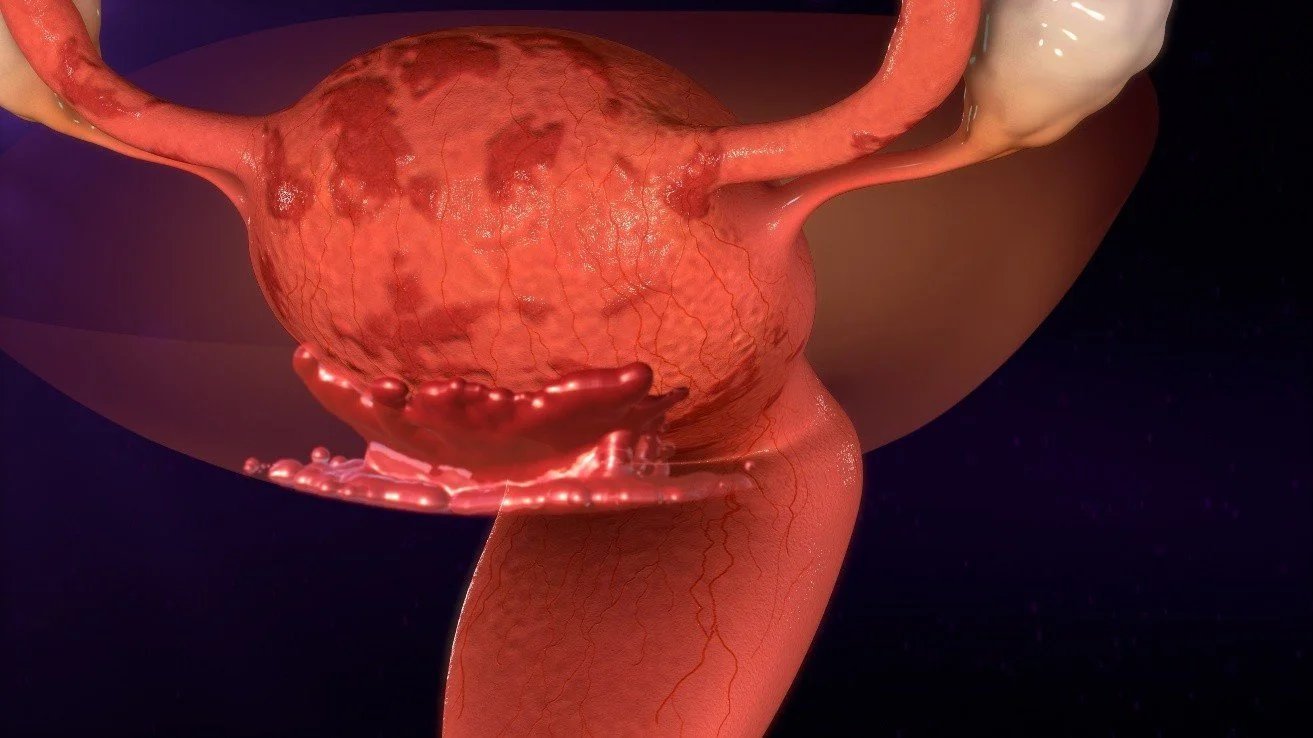
Endometriosis
Do you spend most of the day in bed when you are on your period? Are you missing school or work every month? Does it feel like a wild animal is ripping your insides out every cycle? Still have pain after a hysterectomy? These are real descriptions that we have heard women tell us.
While there are many causes of chronic pelvic pain, the most common is endometriosis. It effects 6-10 percent of all reproductive aged women. It is present in 38 recent of patients who struggle with fertility. It is diagnosed in 71-87 percent of women who report chronic pelvic pain.
People with endometriosis often experience severe pain with menstrual cycles. This pain can lead to vivid descriptions. People often can feel pain with intercourse that is worse during menses. Women also may experience severe cramping and pain with an orgasm. It can invade adjacent structures and cause bladder pain and bowel changes during menses. Ultimately, it can cause neuropathic pain which leads to wildly vivid descriptions such as “a wild animal ripping my insides out.”
Historically, the diagnosis was made by performing a surgery called a diagnostic laparoscopy with biopsies to prove the existence of endometriosis. However, most of the time, the diagnosis is made based on clinical history and physical. On a physical exam, your doctor may find modularity on the structures that support your uterus. There are no laboratory tests. Ultrasound can be helpful if it finds a cyst called an endometrioma. However, ultrasound and physical examination has a high false negative rate. Therefore, our practice is to make the diagnosis based on clinical history.
Endometriosis occurs when endometrial tissue (the tissue that is shed every month) finds itself in places it doesn’t belong. How this occurs, is not known. This is because no one explanation can explain all cases. The most prevailing theory is a phenomenon called retrograde menstruation. During a menstrual cycle, some tissue is ejected backwards through the fallopian tubes and into the abdomen. Similarly, the menstrual tissue invades the muscle lining of the uterus and leads to a condition called adenomyosis.
However, this does not explain all cases of endometriosis. There are rare case reports of people coughing up blood every time they have a cycle or a patient even having stroke while on her cycle. In these rare cases, evaluation showed endometrial tissue in the lung and on the brain. Theories of how this occurred involve lymphatic spread and a phenomenon called celomic metaplasia. Celomic metaplasia refers to normal tissue that changes itself into endometrial tissue.
Regardless of how the implants get there, they often bleed every month leading to pain. In addition, the implants upregulate the inflammatory pathway increasing pain. They also can start making their own estrogen to self-stimulate and become resistant to progesterone. Treatments are often multidisciplinary and involve managing the specific issues that one is experiencing. It is important to realize that a complete pain cure, meaning no pain, may not be possible. Even in women who undergo a hysterectomy with ovarian removal, 5-10 percent of women still experience pain.
Medical Treatment Examples
· Nonhormonal
Ibuprofen or Naproxen taken 3 days prior to and throughout menses
Tranexamic acid taken for the 5 days per month while on menses
Vitamin C, Vitamin E and N-acetylcysteine
· Menstrual suppression
Contraception either cyclic, extended cycle or continuous
Depo-provera
Intrauterine device (IUD)
Progesterone only, Provera, norethindrone
aromatase inhibitor with OCP
· Surgical
Endometrial ablation
hysterectomy
· GnRH antagonist
· Pain Modulation
Amitriptyline
Duloxetine (Cymbalta)
Pregabalin
Call today for an appointment!